Evolution of AI
We are still at the very beginning of creating true artificial intelligence, even if recent progress makes it feel otherwise. The foundational ideas behind neural networks date back decades—gaining traction around the late 20th century—but for most of that time they were limited by insufficient computing power and a lack of large-scale data. Only in the past 20 years have advances in hardware, along with massive datasets generated through everyday human activity—like labeling images via CAPTCHAs or interacting with digital platforms—enabled these systems to improve rapidly. Even more recently, researchers have begun experimenting with integrating biological neural fibers with traditional computing hardware, hinting at a future where machines may not just simulate intelligence but embody it in fundamentally new ways. If that trajectory continues, what we currently call AI may one day be seen as a primitive precursor to something far more sophisticated and truly autonomous.
60 Years of Discovery
A lot of technologies first discovered or developed in the mid-1900s took decades to reach everyday consumers because turning a breakthrough into something practical, affordable, and scalable is a long process. Early innovations like the transistor, invented in 1947, or the integrated circuit in the late 1950s, were initially confined to laboratories, government projects, and specialized industries due to high costs and limited manufacturing capability. It took years of engineering refinement, infrastructure development, and mass production techniques before these technologies could be miniaturized and produced cheaply enough for consumer products like radios, calculators, and eventually personal computers. Along the way, companies had to solve reliability issues, standardize components, and build entirely new supply chains. This pattern—slow early progress followed by rapid adoption once conditions are right—helps explain why even transformative ideas can take a generation to fully reach and reshape everyday life.
Dot-Com Boom
The dot-com boom was a period in the mid-to-late 1990s when excitement about the internet drove massive investment into online companies. As the web became more accessible, investors rushed to fund startups with “.com” in their names, often valuing them based on future potential rather than proven profits. This surge was fueled by advances in computing, widespread adoption of personal computers, and the opening of the internet for commercial use, building on earlier innovations like the World Wide Web. Many companies raised huge amounts of money through IPOs despite having untested business models, leading to rapid growth—but also speculation and unrealistic expectations. By the early 2000s, the bubble burst in what’s often called the dot-com crash, when many of these companies failed, stock markets fell sharply, and billions of dollars in value disappeared. However, the boom wasn’t pointless—it funded infrastructure and laid the groundwork for today’s internet giants, showing that even speculative bubbles can accelerate long-term technological progress.
30 Years of Experience
Our team got its start in the 1990s, back when email meant telnetting into a mail server through a command prompt. From there, we moved into learning HTML, CSS, and PHP to design and build websites. That naturally evolved into an infrastructure-focused path, where we worked with computer networking, microwave communications, and data center administration.
When Facebook launched, social media marketing quickly became all the rage, opening up entirely new ways to connect and engage. Soon after, the Internet of Things (IoT) emerged, connecting everything from watches to refrigerators and bringing automation into nearly every corner of the globe.
Today, we’re in the age of AI—where intelligent tools and agentic platforms help us create, automate, and manage nearly every aspect of our lives. It’s the era many of us in tech have been anticipating for decades, and in many ways, it feels like we’re just getting started.
Roadmap
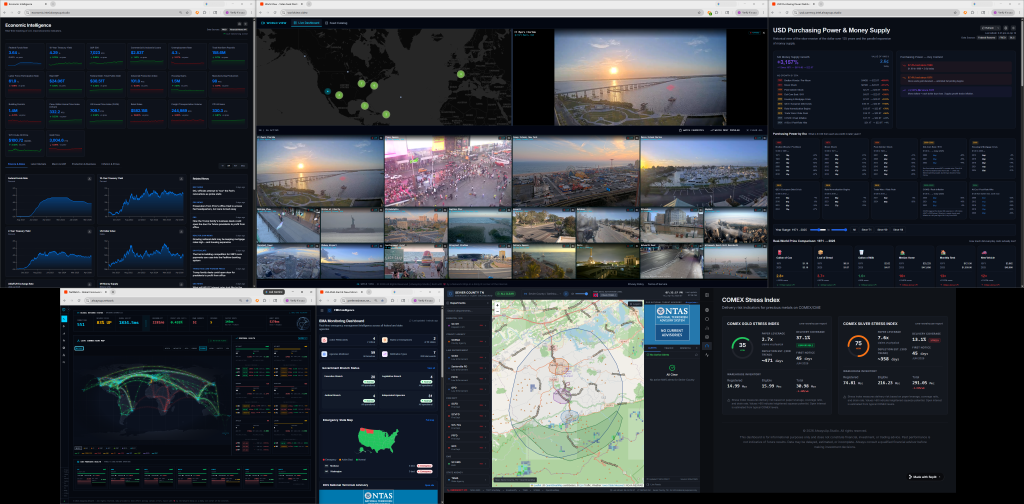
Our initial Goal: Create real-time monitoring dashboards for critical local, state, national and world view information including, but not limited to, critical minerals, currency, bond, metals and equity markets, inflation/purchasing power and actual eyes-on view of the world.
The Challenge: Use AI “Vibe Coding” tools to create 7 Dashboards in 7 Days.
The Platform: These critical resource & infrastructure monitoring dashboards were all created using Replit.
Dashboards
- Critical Minerals / COMEX critical-minerals.intel.alwaysup.studio
- EMA Emergency Management Agency Monitoring preferrednews.network
- USD Purchasing Power & Money Supply usd.currency.intel.alwaysup.studio
- Global Communications Status alwaysup.network
- Economic Intelligence economic.intel.alwaysup.studio
- WorldView worldview.video
- Sevier County, Tennessee Alert Dashboard sevier.tn.intel.alwaysup.studio
- LexGraph – Document Analysis lexgraph.alwaysup.studio
The Future
We are currently testing other platforms such as Base44 to facilitate the processing of information from Google Calendars to Google Sheets and then input into Quickbase.com Applications. We are also looking at Browser AI Assistants, OS AI Assistants, Programming AI Assistants such as Devin.
That’s just the start. The AI world of content creation is even more vast and to think most of these services have launched just in the last year or so. Services such as ElevenLabs.io and Mureka.AI offer AI music generation, image & video studios that create & produce high quality content with ease.
AI in the Work Place | Service examples
- CEO: Microsoft Copilot, Open Interpreter, Rewind.
- CFO: AlphaSense, Jedox, Anaplan.
- COO: Zapier AI, Airtable AI, n8n.
- Executive Assistant: Dialpad, Goodcall, Calendly.
- Creative: ElevenLabs Image & Video, Kapwing Personas, Runway.
- Marketing: Buffer AI, Jasper, Surfer AI.
- Sales: HubSpot AI, Apollo, Salesloft.
- Support: Intercom Fin, Zendesk AI, Ada.
- HR: Greenhouse AI, Rippling, Eightfold AI.
- IT: ServiceNow Now Assist, Okta AI, Datadog AI.